
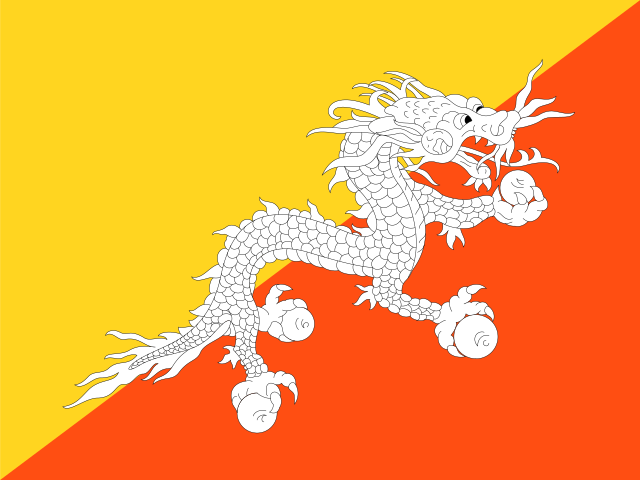
 Southern Asia
Bhutan is a small Himalayan country between Tibet and India. Known as the Land of the Thunder Dragon, it has mountain scenery and strong Buddhist traditions. Its capital is Thimphu.
Why go
Himalayan scenery and mountain valleys.
Buddhist temples, monasteries and traditional architecture.
Cultural visits to Paro, Thimphu, Punakha, Phobjikha and Jakar.
Birdwatching and wildlife viewing in Zhemgang.
Archery competitions, traditional crafts and hot stone baths.
Best time to go: March to June for flowering jacaranda and rhododendron trees, or October to December for clear views of the snowy Himalayas. Weather varies greatly with altitude.
Getting there
By air
- Paro International Airport is Bhutan's only entry point by air. It is in western Bhutan, near Thimphu.
- Druk Air serves destinations in India and other countries, including Nepal, Bangladesh, Thailand and Singapore. Bhutan Airlines also flies to Bangkok.
- Another option is to fly to Bagdogra Airport near Siliguri in India, then travel by road to Phuentsholing. The drive from Siliguri takes about three hours.
By land
- The three land crossings from India are Phuentsholing in the west, Gelephu in the centre and Samdrup Jongkhar in the east. There are no open crossings along the northern border with China.
- Road permits are required. A local tour operator can arrange them.
- Government buses connect Kolkata's Esplanade bus station with Phuentsholing. The journey takes about 18 hours.
Getting around
Car and driver
A local tour operator can provide a vehicle and driver for your stay. Traffic keeps to the left. Mountain roads are narrow and winding, and traffic accidents are common. Rockfalls and landslides can block roads, especially from June to August. Avoid long road journeys during this period where possible. Carry plenty of bottled water and snacks in summer because road clearance can take time. The road through Thrumshingla Pass between Bumthang and Mongar has spectacular scenery. Rockfalls can cause long waits, especially in wet weather.
Bus and shared taxi
Local and inter-district buses stop often and can be uncomfortable. Private buses and shared taxis leave from near the Phuentsholing bus station. The many sharp bends can cause travel sickness. Consider carrying travel sickness tablets. Drukride offers online bus booking, but its registration and app often do not work.
Domestic flight
Flights connect Paro with Yongphula near Trashigang, Bathpalathang in Jakar and Gelephu. Flights can save time compared with winding road journeys. Schedules are limited and cancellations are common.
What to see and do
Paro and Thimphu
Both are popular stops on cultural tours of Bhutan.
Punakha
A popular cultural destination in a lower valley, with pleasant winters and hot summers.
Phobjikha and Jakar
Both are among Bhutan's popular cultural tour destinations.
Zhemgang
This region offers birdwatching and excellent wildlife viewing.
Eastern Bhutan
A less explored region that has opened to tourism.
Watch archery
Archery is Bhutan's national sport, with competitions held around the country most weekends. Visitors are welcome to watch and join the cheering.
Food and drink
Ema datshi
Bhutan's national dish combines chillies and local cheese. Versions may include vegetables or yak cheese.
Momos
Tibetan-style dumplings filled with pork, beef, or cabbage and cheese.
Phaksha paa
Pork cooked with spicy red chillies, sometimes with radishes or spinach.
Hoentoe
Buckwheat dumplings filled with turnip greens, cheese, spinach and other ingredients.
Jasha maru
Spicy minced chicken with tomatoes and other ingredients, usually served with rice.
Red rice
A filling rice that becomes pale pink, soft and slightly sticky when cooked.
Money
Bhutanese ngultrum, written Nu.; its currency code is BTN.
- The ngultrum is fixed to the Indian rupee at one to one. Ngultrum is not accepted in India.
- Use Indian notes below ₹200 to avoid restrictions on larger notes. Government establishments follow a ban on Indian notes of ₹200 or more, while private businesses may vary.
- US dollars are widely accepted. Keep local currency for small purchases and souvenirs.
- Banks and major hotels exchange major currencies.
Typical costs
- A Sustainable Development Fee, a government visitor charge, is listed as US$100 per day as of summer 2023, except for visitors from India and Bangladesh.
- The visitor charge is waived for a one-night stay at Phuentsholing, Gelephu or Samdrup Jongkhar.
- Entry to certain religious sites and nationally important buildings costs Nu.500–1,000 for foreigners. This is separate from the daily visitor charge.
- A taxi from Siliguri to Phuentsholing costs around ₹2,800–3,800, depending on the vehicle and time of day.
- A bus from Siliguri to the Indian border town of Jaigaon costs around ₹200.
- The Kolkata–Phuentsholing government bus costs around ₹300 or Nu.300.
Language
- Dzongkha is the national language and is widely spoken in western Bhutan.
- English is widely understood and is used for teaching in schools.
- Sharchopkha, also called Tshangla, is the main regional language in eastern Bhutan.
- Bumthangkha is the main regional language in Bumthang.
- Nepali is understood by a large majority of Bhutanese.
- Some people understand Hindi, though it is less widely spoken than Nepali.
- La
- A respectful ending added to speech, including English expressions such as 'Yes-la'.
- I'll reach you to the bus station
- I'll take you or accompany you to the bus station.
- Cousin-brother or cousin-sister
- A cousin; these terms reflect close family relationships.
- BST
- Bhutan Standard Time; it is also jokingly called 'Bhutan Stretchable Time' when someone is late.
Staying safe
- Bhutan is generally very safe for travellers.
- Do not leave money or valuables in vehicles, especially at tourist sites. Thefts from vehicles have been reported.
- Police in Thimphu patrol regularly, speak English and are described as helpful.
- Bears can be a threat in remote mountain areas.
Local customs
Do
- Show respect to older people and those in positions of authority.
- Pass sacred stones, stupas and other religious objects with your right side nearest to them. Turn prayer wheels clockwise.
- Remove shoes and headgear when visiting temples. Wear respectful clothing and ask your guide for advice.
- Ask permission before taking photos or videos in temples and monasteries.
- Carry small notes if you wish to donate at monasteries. Donations are customary but optional.
Don't
- Do not speak disrespectfully about the king or royal family.
- Do not try to convert people to your religion. This is illegal and can lead to imprisonment.
- Do not sit on sacred stones or stupas.
- Avoid shorts and revealing clothing at temples and dzongs, which are fortified buildings.
- Do not smoke at monasteries or in public places. Larger cafes and restaurants may have designated smoking areas.
- Do not harm protected wildlife or litter. Both are illegal.
Staying healthy
- Do not drink untreated tap water. Drink water that has been thoroughly boiled or otherwise purified.
- Illnesses spread through unsafe water are a concern, especially during the summer monsoon. These include diarrhoea, dysentery, giardia and typhoid.
- Altitude sickness can start at 2,500 metres. If you develop a racing heartbeat, shortness of breath or severe headache, tell your guide and go lower immediately.
- Hospitals and clinics exist throughout Bhutan, but advanced facilities are limited. Doctors may be away from smaller health units.
Phone and internet
- Bhutan Telecom and Tashi Cell have kiosks before the exit at Paro Airport.
- As of April 2025, both offered unlimited fourth-generation mobile data, called 4G, for 14 days at Nu.2,000.
- You can also register for a B-Mobile phone card at an office using your passport. Ask staff to activate data and test the connection before leaving.
- B-Mobile recharge cards are sold in most general stores.
Where to stay
- All towns reached by road have hotels, but standards vary considerably.
- Hotels of international standard are mostly in major towns and tourist areas.
- Five-star accommodation is available in Paro, Jakar, Punakha, Gangtey and Thimphu.
- The tourism ministry lists homestays, including accommodation in areas without hotels.
Trips to Bhutan
Day-by-day itineraries by snuck, shaped around you.
Outdoor adventures in Bhutan
Bhutan offers mountain treks, forest hikes, wildlife watching and hot springs. Spring and autumn are best for most treks, but many mountain routes are tough and require carrying all food and camping equipment.
Tiger’s Nest Monastery hike
HikeWestern Bhutannear Paro
2–3 hours uphill to the monasteryStart at the parking lot below Taktsang Monastery. Buy your entry ticket there, then follow the clear uphill path through forest.
- Cost: Nu1,000 entry for foreign nationals
Druk Path Trek
TrekWestern Bhutannear Paro
Spring and autumnStart in Paro and follow the trekking route to Thimphu. Carry all food and camping equipment for the higher sections.
- Summer paths can be very muddy; winter paths can be snow-covered.
- Altitude sickness can begin at 2,500 m. Tell your guide and descend immediately if you develop severe headaches, shortness of breath or palpitations.
Jomolhari Trek
Trek
Spring and autumnCarry all food and camping equipment for the higher trekking areas. A starting point and booking arrangements are not specified.
- Summer paths can be very muddy; winter paths can be snow-covered.
- Altitude sickness can begin at 2,500 m. Tell your guide and descend immediately if serious symptoms develop.
Laya Gasa Trek
Trek
Spring and autumnCarry all food and camping equipment for the higher trekking areas. A starting point and booking arrangements are not specified.
- Summer paths can be very muddy; winter paths can be snow-covered.
- Altitude sickness can begin at 2,500 m. Tell your guide and descend immediately if serious symptoms develop.
Snowman Trek
Trek
Experts only About 30 days Mid-June to mid-OctoberPrepare to carry all food and camping equipment for the higher trekking areas. A starting point and booking arrangements are not specified.
- Reported to be one of the toughest treks in the world.
- Altitude sickness can begin at 2,500 m. Tell your guide and descend immediately if serious symptoms develop.
Bumthang Cultural Trek
TrekBumthang, Central Bhutannear Jakar
Spring and autumnUse the trek to explore the countryside around Jakar in Bumthang. Access and booking arrangements are not specified.
- Summer trekking paths can be very muddy; winter paths can be snow-covered.
Chumbu Monastery hike
HikeWestern Bhutannear Paro
About 3 hours to the monasteryStart at Kuenga High School in Doteng, 8 km north of Paro. Follow the river valley towards the monastery.
- The final 30 minutes climb a very steep slope.
Drakhapo cliff walk
HikeWestern Bhutannear Paro
5 minutes from the end of the dirt roadAbove Shaba, keep Shaba School on your right and follow the dirt road to its end. Walk from there to the cliffside complex.
Chimi Lhakhang walk
HikePunakha Valleynear Punakha
About 30 minutes from the road Early morningWalk from the road through paddy fields to Chimi Lhakhang.
Khamsum Yuelley Namgyel Chorten hike
HikeUpper Punakha Valleynear Punakha
About 1 hour uphillHike uphill to the chorten in the upper Punakha Valley. The exact starting point is not specified.
Jana village hike
HikePunakha Valleynear Punakha
3–3.5 hours return, including time to exploreStart at the suspension bridge near Kichu Resort. Cross the Dang Chhu river, then follow the route through a village and rice fields to Jana.
Dochu La to Thinleygang hike
HikeBetween Dochu La and Punakhanear Punakha
About 5 hours Spring for flowering plantsDrive about 15 minutes from Dochu La pass to the start below the tourist cafeteria. Walk downhill to Thinleygang and arrange a car pickup for Punakha or Thimphu.
Lamperi to Lumbitsawa hike
HikePunakha areanear Punakha
Just over 4 hours one way Early spring and autumnStart at Lamperi Park and follow the downhill forest route to Lumbitsawa.
- Avoid this route in summer, when it can be muddy and bears may be encountered.
Dochu La to Lungchuzekha Gompa hike
HikeDochu La area
3–4 hours returnStart at the 108 chortens at Dochu La. Climb through rhododendron forest and take the left branch to Lungchuzekha. Return the same way, or descend via Tashigang Goempa to a driver pickup at Hongtsho.
- The climb includes some steep sections.
Geon Tsephu sacred caves
CaveMitesgang, Punakha Valleynear Punakha
About 2 hours on foot from the highwayFrom the highway at Mitesgang, take a short drive up a rough road or walk for about two hours to the temple and caves. Mitesgang is about 12 km down the valley from Punakha Dzong.
- Leeches are common in summer.
- Some parts of the sacred site involve scrambling through rock.
Koma Tsachu hot springs
Hot springMitesgang, Punakha Valleynear Punakha
Visit the springs near the small community of Mitesgang. Bring sleeping bags and mats if staying in the simple accommodation.
- Cost: No charge to stay in the four-room building; bathing price not specified
Zhemgang birdwatching and wildlife watching
WildlifeZhemgang
Head to the Zhemgang region for birdwatching and wildlife viewing. Specific access routes and tour arrangements are not specified.
Gelephu-area wildlife watching
WildlifeGelephu areanear Gelephu
Use Gelephu as the town for exploring the surrounding wildlife area. Specific viewing sites and visitor arrangements are not specified.
Motithang Takin Preserve
WildlifeMotithang, Thimphunear Thimphu
Visit the Takin Preserve in Motithang, Thimphu. Transport and booking arrangements are not specified.
Amo Chuu crocodile breeding centre
WildlifePhuentsholingnear Phuentsholing
Go to the riverbank behind Phuentsholing’s bus station to visit the breeding centre.
Watch Bhutanese archery
More to doAcross Bhutan
Most weekendsAttend a local archery competition. Events take place across the country, and visitors are welcome to watch and cheer.
Traditional hot stone bath
More to do
Traditionally after darkTake a traditional bath in a wooden tub heated with hot river stones. Specific venues and booking arrangements are not specified.
Airports, metros and trains in Bhutan
Airports with scheduled flights
- PBHParo International AirportParoMain international airport
People and safety in Bhutan
Religion
Most people are Buddhist. Mixed.
- Buddhist75%
- Hindu25%
- Folk religions2%
LGBT+ travellers
Legal
- Same-sex marriage is not recognised.
- Legal gender change is recognised.
- Some laws protect against discrimination.
Women travellers
Ranked #99 of 181 countries for women's safety, inclusion and justice.
59% of women say they feel safe walking alone at night where they live.
Who can visit without a visa
Travellers from 3 of 198 countries can visit Bhutan easily: no visa, a visa at the airport, or a short online form.
- Freedom of movement1
- Visa on arrival2
- eVisa193
- Visa required2
Who can visit easily, by part of the world
For each part of the world: how many countries' travellers can come easily. Easy means no visa, a visa at the airport, or a short online form.
- Asia3 of 49 countries
- Africa0 of 54 countries
- Europe0 of 46 countries
- Americas0 of 35 countries
- Oceania0 of 14 countries
Questions
When is a good time to visit Bhutan?
March to June brings flowering trees. October to December offers clear skies and views of the snowy Himalayas.
Can I reach Bhutan without flying?
Yes. You can enter by road from India through Phuentsholing, Gelephu or Samdrup Jongkhar; Bhutan has no railway.
Can I get help booking travel in person?
A local tour operator can arrange a vehicle and driver. Tickets for buses from Siliguri to Phuentsholing are sold at a counter near the bus.
Should I carry cash?
Yes. Cash machines can be unreliable, and local currency is useful for small purchases and souvenirs.
Will I be able to communicate in English?
English is widely understood because it is used for teaching in Bhutanese schools.
Is Bhutanese food spicy?
Yes. Chillies are a main ingredient, so clearly request less spicy food before ordering if needed.
What accommodation is available?
Towns reached by road have hotels of varying standards. Listed homestays also provide accommodation in areas without hotels.
Can I drink tap water?
No. Water should be thoroughly boiled or otherwise purified before drinking.
What should I wear when visiting temples?
Wear respectful clothing and avoid shorts or revealing clothes. Remove your shoes and headgear when entering temples.
Can mountain travel cause altitude sickness?
Yes, it can begin at 2,500 metres. Tell your guide and descend immediately if you develop a racing heartbeat, shortness of breath or severe headache.
 Reviewed by @snuck