
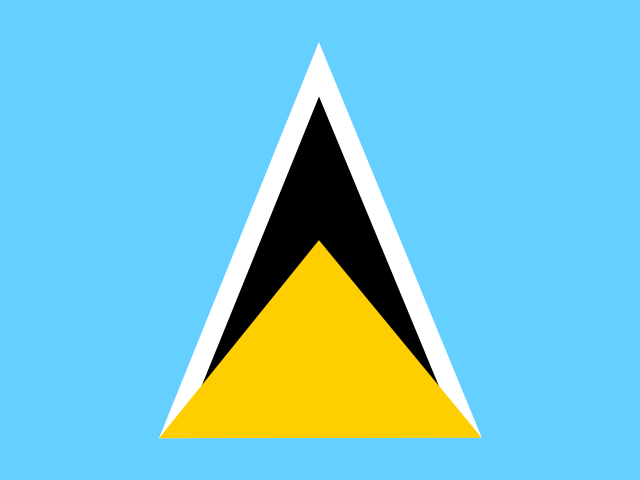
 Caribbean
Saint Lucia is an island nation in the Caribbean. It is known for tropical weather, mountainous scenery, beaches and a wide choice of places to stay.
Why go
The Pitons are two striking volcanic peaks south of Soufriere.
Soufriere has hot springs, waterfalls, gardens and reefs.
Pigeon Island National Park has historic buildings and sea views.
Major events include the Jazz and Arts Festival in May, Carnival in July and Creole Heritage Month in October.
Best time to go: January through April is the dry season. The rainy season runs from May through September.
Getting there
By air
- George FL Charles Airport (SLU) is near Castries and serves flights between Caribbean islands. It is closer to many resorts than Hewanorra.
- Hewanorra International Airport (UVF) is near Vieux Fort. International flights from Europe and mainland North America arrive here.
- Many northern resorts are a 1 to 1.5 hour drive from Hewanorra. The source gives a taxi price of US$80–90 to the Rodney Bay resort area.
By sea
- Cruise ships dock in Castries. Attractions can get busy when ships are visiting.
- Express des Isles operates ferries to neighbouring islands, including Martinique and Guadeloupe. The source lists a one-way Martinique fare of €69 online, plus EC$33 harbour tax paid at the terminal.
Customs
- Camouflage clothing and luggage are illegal for people who are not military personnel. A camouflage bag may be confiscated at the airport.
Getting around
Taxi
Ask your hotel for a taxi operator or agency it regularly uses. Prices are generally fixed, but comparing operators can help you find a better rate. Tours arranged through resorts are usually the most expensive option. A local taxi operator may offer a cheaper tour.
Local bus
Local buses are small vans carrying about 10–14 people. They are cheap, but their condition varies. Services run often but do not follow a regular timetable. Many travel towards Castries in the morning and return later in the day. Ask local hotel staff about your route and travel time before setting off.
Water taxi
Water taxis connect coastal towns and beaches. Many Soufriere operators wait at the jetty. Prices can be negotiated. Operators near the Hummingbird Hotel and Soufriere beach may offer cheaper rates. From Soufriere, water taxis go to Anse Chastenet and Jalousie beaches.
Rental car
Drive on the left. Drivers need a permit, listed at US$12 for one day or US$21 for three months. Roads can be narrow, steep and rough. Driving requires confidence. A four-wheel-drive vehicle or similar vehicle with extra ground clearance is necessary for mountain roads.
What to see and do
The Pitons
Gros Piton and Petit Piton are two cone-shaped volcanic peaks rising beside the sea. They are a World Heritage Site and appear on the national flag.
Pigeon Island National Park
The park has some of Saint Lucia's oldest buildings, including Fort Rodney, a former British military base. It also has views towards Martinique.
St. Lucia Botanical Gardens
The gardens are among the attractions around Soufriere.
The green flash at sunset
In rare conditions, a brief green flash appears just as the sun disappears. A hot, calm day and a clear sea horizon give you a chance to see it.
Climb Gros Piton
Allow about two hours for the moderate to strenuous climb and another 1.5 hours to descend. A guide is required, and entrance costs US$50.
Bathe at the Sulfur Springs
These hot springs lie south of Soufriere. Bring swimwear for the pool fed by hot water.
Food and drink
1931
A premium rum series made in limited batches each year.
Chairman's Reserve
A rum range with spiced, white and dark varieties.
Crystal Lime
A rum-based lime liqueur.
Bounty
A widely available red rum commonly drunk on the island.
Marigot Bay Liqueurs
Rum-based cream liqueurs with flavours including coconut and banana.
Piton Lager
A locally brewed and bottled beer containing 5% alcohol.
Money
Eastern Caribbean dollar (XCD), written as EC$ or $.
- The Eastern Caribbean dollar is fixed to the United States dollar at US$1 = EC$2.70.
- Castries market and JQ Shopping Mall in Rodney Bay sell gifts.
- La Place Carenage and Point Seraphine in Castries have duty-free shops. You may need identification showing that you are a visitor to qualify for duty-free prices.
- Supermarkets offer good prices on rum produced or bottled on the island.
Typical costs
- Taxi from Hewanorra Airport to Rodney Bay: US$80–90.
- Gros Piton entrance: US$50; a guide is required.
- Driving permit: US$12 for one day or US$21 for three months.
- Express des Isles ferry to Martinique: €69 one way online, plus EC$33 harbour tax.
- Channel Shuttles ferry to Martinique: EC$235 including departure tax.
Language
- English is the official language, and almost all residents can speak it.
- French patois is also spoken.
- No thank you
- A polite way to decline a street vendor's offer.
Staying safe
- Stay in groups where possible and take care in secluded areas. The source reports violent crime and muggings.
- Hide valuables before entering the water. The source reports armed muggings of people while they are in the water.
- Watch your belongings in crowded places because of pickpockets.
- Camouflage clothing and items resembling military uniforms are illegal for people who are not military personnel. This also applies to luggage.
Local customs
Do
- Use a simple, polite "no thank you" to decline street vendors.
- Remember that all beaches on Saint Lucia are open to the public.
Don't
- Do not sunbathe nude; it is illegal.
- Do not wear camouflage clothing or carry camouflage luggage unless you are military personnel.
Staying healthy
- Tap water is safe to drink. Bottled water is also widely available.
- Winding roads can cause motion sickness, especially between Castries and Soufriere.
- If you are prone to motion sickness, prepare for the airport transfer before travelling. The drive from Hewanorra to the north takes about 90 minutes.
Where to stay
- Resort hotels are widely available, including all-inclusive resorts.
- Small boutique hotels offer another option.
- Self-catering stays include villas, condos and holiday apartments.
Outdoor adventures in Saint Lucia
Saint Lucia has steep volcanic peaks, rainforest walks and many beaches. Around Soufriere, you can climb the Pitons, dive between them, visit waterfalls and soak in hot springs.
Gros Piton
HikeSouth of Soufrierenear Soufriere
Hard About 2 hours up and 1½ hours downTake a taxi or local bus to the trailhead. A guide is required for the climb.
- Cost: US$50 entrance
- Expect moderate to strenuous hiking.
- Start early and go with the required guide.
Petit Piton
ClimbingSouth of Soufrierenear Soufriere
HardClimb with a guide and set out early.
- This is a technical climb, with some sections requiring ropes.
- You need upper body strength for parts of the route.
Sulphur Springs
Hot springMalgretoute, south of Soufrierenear Soufriere
Early in the day, before the heat and cruise ship crowdsVisit the drive-in volcanic crater on Sulphur Springs Access Road. You can pay for entry or take a tour.
- Cost: Around US$9 entry; around US$15 with a tour
Tet Paul Nature Trail
HikeSoufriere areanear Soufriere
Easy Around 45 minutesWalk the trail with a guide.
- Cost: US$10 or XCD27 entry
Diving between the Pitons
Scuba divingThe Pitons, Soufrierenear Soufriere
For diving enquiries, call +1 758 484 3346 or +1 758 285 7354.
Pigeon Island diving
Scuba divingPigeon Islandnear Gros Islet
For diving enquiries, call +1 758 484 3346 or +1 758 285 7354.
Jalousie Beach
BeacheBetween the Pitonsnear Soufriere
Enter via Sugar Beach Hotel.
- Cost: US$115 for two chairs and an umbrella
- Keep valuables hidden while you are in the water.
Anse Chastanet Beach
BeacheNorth of Soufrierenear Soufriere
Follow the hilly coastal route north out of Soufriere. It is separate from the main highway.
- Keep valuables hidden while you are in the water.
Anse Mamin Beach
BeacheBeside Anse Chastanet Beachnear Soufriere
Walk about 10 minutes from Anse Chastanet Beach.
- Stay in a group and take care in secluded areas.
- Keep valuables hidden while you are in the water.
Diamond Botanical Gardens and thermal springs
Hot springSoufriere Estatenear Soufriere
Visit Soufriere Estate for the gardens and waterfall. Pay an extra fee to use the thermal springs or private baths.
- Cost: Garden and waterfall: US$7 or XCD17.50. Thermal springs: an additional US$6 or XCD15. Private baths: an additional US$7 or XCD17.50.
Toraille Waterfall
More to doSoufriere areanear Soufriere
Visit the waterfall in the Soufriere area. Detailed transport and access arrangements are not specified.
Morne Coubaril Estate ziplining
More to doSoufriere areanear Soufriere
Take a ziplining tour at Morne Coubaril Estate.
Morne Coubaril Estate waterfall hike
HikeSoufriere areanear Soufriere
Join the waterfall hike offered by Morne Coubaril Estate.
Northern rainforest ziplining
More to doNorthern Saint Lucia
Join one of the ziplining courses offered in the north of the island. Individual operators are not specified.
Edmund Rainforest
More to do
Access arrangements for Edmund Rainforest are not specified.
Pigeon Island nature reserve
More to doJust north of Gros Isletnear Gros Islet
Visit the reserve just north of Gros Islet.
Vigie Beach
BeacheCastriesnear Castries
Visit Vigie Beach while in Castries. Detailed transport arrangements are not specified.
- Keep valuables hidden while you are in the water.
Soufriere Beach Park
BeacheSoufrierenear Soufriere
Visit the beach park right in Soufriere.
- Keep valuables hidden while you are in the water.
Saint Lucia beach snorkelling
Snorkelling
Several beaches are suitable for snorkelling, but specific beach names and arrangements are not given.
- Keep valuables hidden while you are in the water.
Airports, metros and trains in Saint Lucia
Airports with scheduled flights
- UVFHewanorra International AirportVieux FortMain international airport
People and safety in Saint Lucia
Religion
Most people are Christian. Mostly one faith.
- Christian91%
- No religion6%
- Other2%
- Folk religions<1%
LGBT+ travellers
Legal
- Same-sex marriage is not recognised.
- Some laws protect against discrimination.
Who can visit without a visa
Travellers from 144 of 198 countries can visit Saint Lucia easily: no visa, a visa at the airport, or a short online form.
- Visa not required92
- Freedom of movement2
- Visa on arrival50
- Visa required54
Who can visit easily, by part of the world
For each part of the world: how many countries' travellers can come easily. Easy means no visa, a visa at the airport, or a short online form.
- Oceania14 of 14 countries
- Americas30 of 34 countries
- Europe39 of 46 countries
- Africa37 of 54 countries
- Asia24 of 50 countries
Questions
When is the dry season?
The dry season runs from January through April. The rainy season runs from May through September.
Which airport will I arrive at?
Flights from Europe and mainland North America arrive at Hewanorra International Airport near Vieux Fort. George FL Charles Airport near Castries serves flights between Caribbean islands.
Can I get around without renting a car?
Yes. Taxis are the main transport used by tourists, while cheaper local buses run without a regular timetable.
What money does Saint Lucia use?
The currency is the Eastern Caribbean dollar, written as EC$ or XCD. Its exchange rate is fixed at US$1 = EC$2.70.
Will I be able to speak English with local people?
Yes. English is the official language, and almost all residents can speak it.
Can I drink the tap water?
Yes. Tap water is safe to drink, and bottled water is widely available.
Do I need a guide to climb Gros Piton?
Yes, a guide is required. Allow about two hours to climb and another 1.5 hours to come down; entrance costs US$50.
Are all beaches open to the public?
Yes. All beaches on Saint Lucia are open to the public.
What kinds of accommodation are available?
Options include resort hotels, small boutique hotels, villas, condos and holiday apartments.
What numbers should I call in an emergency?
Call 911 for fire or emergency medical services. Call 999 for the police.
 Reviewed by @snuck